
Compute 101: Why AI’s New Oil Is a GPU-Hour

Alexis Trujillo
October 11, 2026
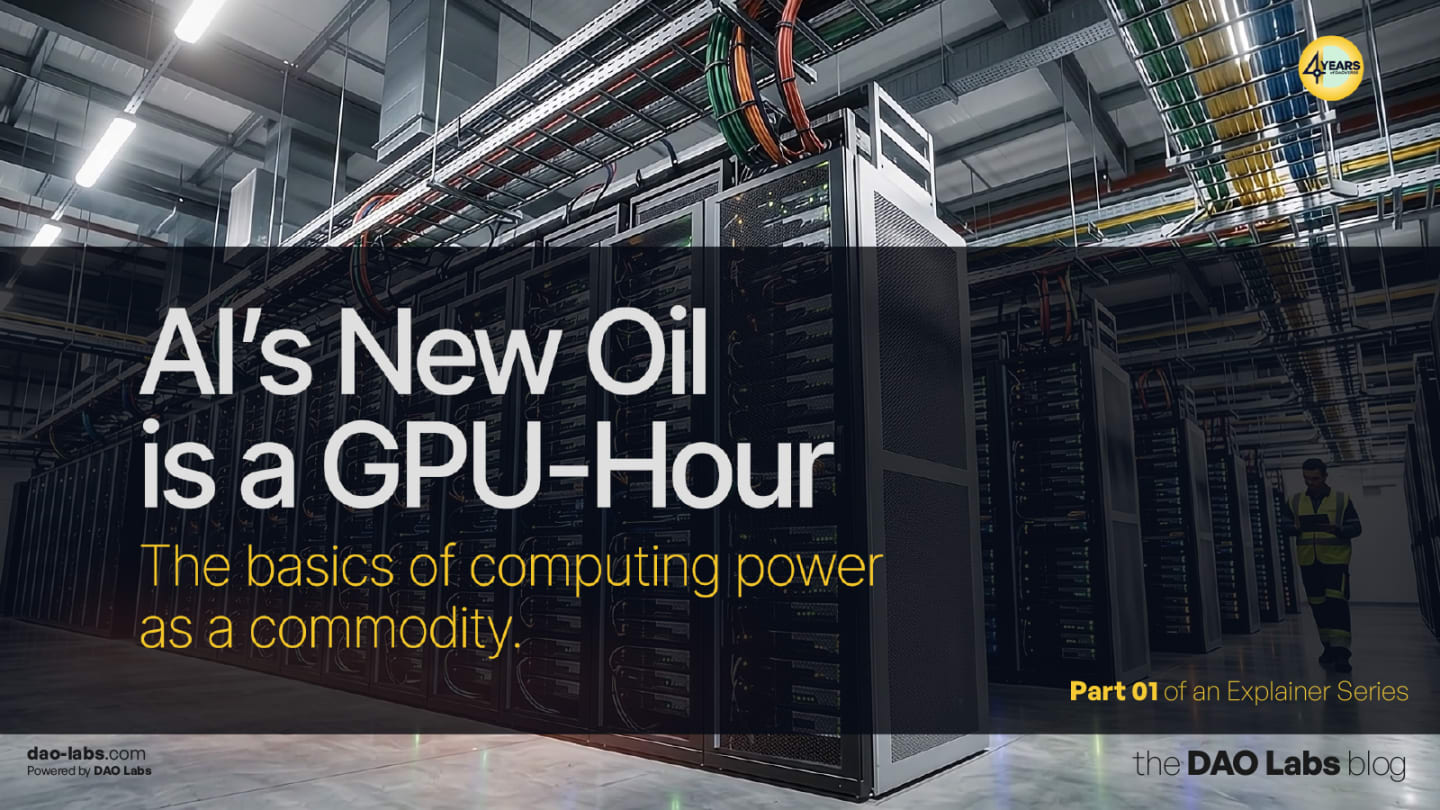
ATR.- For decades, the lifeblood of global industry came in steel barrels or complex money services. When economies boomed, oil consumption spiked; when factories slowed down, drilling tapered off. Entire financial ecosystems, geopolitical alliances, and derivatives markets were engineered around energy extraction.
In 2026, the capital broke that historical pattern. Global AI infrastructure spending is projected to cross roughly $765 billion, surpassing the estimated $681 billion earmarked for traditional oil and gas capital expenditures. Money is voting on what matters most for the next century, and the asset taking center stage isn’t crude in a pipeline—it is raw compute humming in a server rack.
This is Part 1 of our ongoing series, Compute as an Asset, exploring how processing power evolved from an invisible IT line item into a global, tradeable commodity—and what that shift means for the decentralized economy.
What Is “Compute,” Really?
Stripped of industry jargon, compute simply refers to raw calculation muscle: the processing power required to train models, run algorithms, and generate responses.
Think of it this way:
Storage is your digital warehouse—where data rests.
Bandwidth is the highway—how fast data moves from place to place.
Compute is the factory engine—the horsepower that takes raw inputs and turns them into intelligence.
Historically, compute lived on an internal expense sheet. A company bought servers or leased monthly cloud instances from Amazon Web Services or Google Cloud, logged the bill under IT overhead, and moved on.
That dynamic broke when deep learning exploded. Advanced models demand trillions of parallel math operations simultaneously, turning high-end chips—predominantly graphic processing units (GPUs)—into scarce machinery. Because capacity cannot keep up with demand, access to these machines stopped behaving like an office utility bill and began behaving like a scarce, tradeable physical good.
How a Server Rack Turned into a Barrel of Oil
To trade anything on an open market, you need a standardized unit of measurement. With oil, it’s a 42-gallon barrel of West Texas Intermediate or Brent.
With computing power, the benchmark is becoming the GPU-hour:
One hour of operational processing time on an enterprise-grade accelerator (such as an NVIDIA H100 or Blackwell equivalent).
Just like oil, a GPU-hour possesses all the classic characteristics of a commodity:
Fungibility: An hour of model inference on a standardized chip in Virginia does the same math as one in Frankfurt.
Scarcity & Infrastructure Constraints: You cannot instantly conjure more capacity. Building data centers requires physical land, specialized hardware, and massive power grid connections.
Volatile Pricing: When demand surges, spot rates jump; when clusters sit idle, prices soften.
Secondary Markets: Companies locked into long-term hardware contracts are subleasing excess GPU-hours to the highest bidder rather than letting them go dark.
Why This Matters to Social Miners
For anyone active in Social Mining, this mental model is already familiar territory.
Traditional crypto mining proved that digital computation carries real-world economic value: you feed hardware and electricity into a box, and you receive an asset with an open-market price. Social Mining took that insight further, recognizing that human attention, evaluation, and ecosystem work are scarce inputs that produce tangible network equity.
The emergence of compute power as an asset class connects both worlds. We are transitioning out of an era where hardware was just a behind-the-scenes cost and entering one where computing resources, human coordination, and decentralized networks trade alongside one another.
Understanding how a GPU-hour is valued, secured, and traded isn’t just for enterprise data engineers anymore—it is the baseline economic literacy required to navigate the next wave of decentralized infrastructure. In the next part of this series we’ll talk about the elements of this supply chain structure.
Join the Revolution!
Get started with Social Mining today and become a vital part of our growing ecosystem.
Follow our channels:
🌐 Socials: Telegram • Discord • X • Reddit • Medium
🌎 Quick Links: DAO Labs • WhoTweets
Disclaimer: All information shared by DAO Labs is for educational purposes only. Crypto-related activities involve risk; please ensure you are compliant with the regulations in your jurisdiction before participating. Not financial or investment advice.