
What a 1-Person Biotech Acquisition Teaches Social Miners

Alexis Trujillo
November 10, 2026
ATR.- Developing a new medicine has historically been one of the most bureaucratic, capital-heavy endeavors on the planet. Traditional drug discovery demands tens of millions of dollars in venture backing, institutional labs, and large research teams working for years just to produce viable animal data.
That conventional wisdom fractured when Anthropic announced its acquisition of Mithril Medicine—a biotechnology company with exactly one full-time employee.
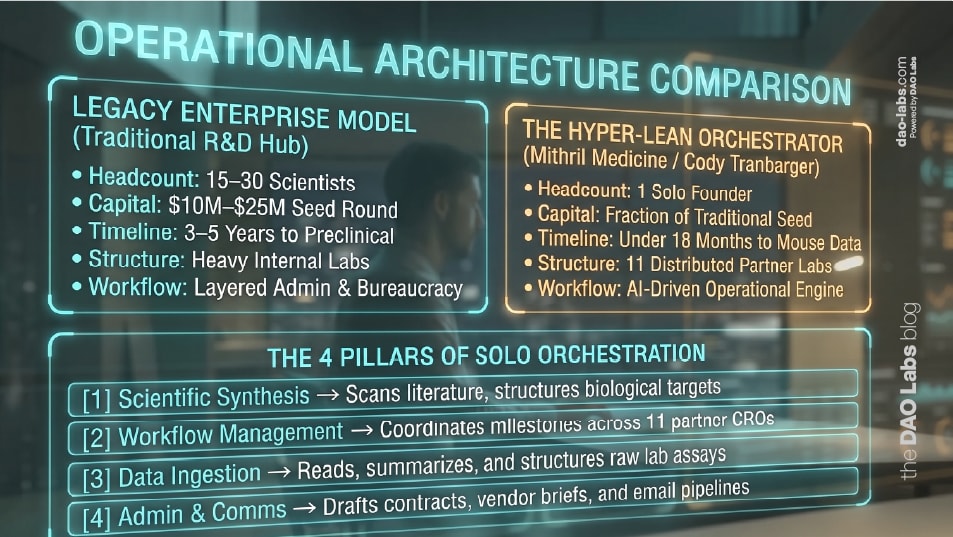
Founded by Cody Tranbarger, Mithril Medicine set out to develop treatments for two rare, life-threatening forms of congenital muscular dystrophy, including LAMA2-CMD. In under 18 months, Tranbarger advanced an antibody therapeutic from pure concept to promising preclinical results in mouse models.
He had no campus, no internal wet-lab technicians, and no enterprise payroll. Instead, he had a handful of part-time scientific advisors, a network of specialized Contract Research Organizations (CROs), and an AI model named Claude serving as his central operating engine.
Infographic Blueprint: The 1-Person Pipeline vs. Legacy Operations
Beyond the Search Bar: Treating AI as an Executive Team
The secret behind Mithril Medicine is not that AI magically synthesized a compound in seconds. Drug discovery still requires real-world wet-lab validation. The breakthrough was operational: Tranbarger refused to treat AI as a simple search bar.
Most everyday users engage generative tools like an alternative to a search engine—asking isolated questions and skimming conversational answers. Tranbarger embedded Claude directly into the operational plumbing of his company:
Logistics & Partner Coordination: Rather than maintaining an internal wet lab, he outsourced physical assays across 11 independent laboratories. The model managed the scheduling, tracked deliverables, and maintained technical continuity between third-party teams.
Data Processing: As raw test figures returned from partner facilities, the model digested technical reports, flagged anomalies, and organized findings.
Administrative Throughput: The model drafted partner communications, technical scopes of work, and grant proposals—eliminating executive drag.
This execution style is not completely without precedent. Early pioneers like Perlara PBC, founded by Ethan Perlstein, demonstrated years ago that distributed networks of CROs could advance rare disease programs with minimal internal staff. More recently, small computational teams such as Divergence Labs utilized Claude to screen over 35,000 antibody candidates against severe food allergies in roughly a month.
What makes the Mithril Medicine story historic is the acquisition itself. By buying Mithril and placing Tranbarger at the helm of its life sciences initiatives, Anthropic validated a crucial reality: headcount is no longer the primary measure of enterprise capability.
Watch the Video Breakdown
This video walks through the mechanics of the acquisition and highlights why this case marks an inflection point in how solo builders operate.
Why This Matters for Social Miners
For Social Miners in ecosystems like DAOVERSE, the Mithril Medicine acquisition offers a tangible operational playbook.
DAO Labs and Social Mining have always operated on meritocratic value creation: participants research, design, code, translate, and audit initiatives for decentralized networks without needing permission from a corporate hiring committee. However, many contributors still fall into the trap of linear output—writing one post, checking one link, or asking one basic prompt.
Here is how to adapt this model directly into your Social Mining workflow:
Shift from Solo Contributor to System Orchestrator: If you are analyzing a project, drafting governance proposals, or auditing technical documentation for a Workdrop, do not stop at superficial summaries. Train your workflow to synthesize whitepapers, cross-reference contract code, evaluate tokenomics models, and generate publication-ready analysis in a unified pipeline.
Remove the Headcount Excuse: You do not need an agency to produce enterprise-grade deliverables. A single Social Miner who builds structured toolchains can organize global community campaigns, design comprehensive marketing strategies, and produce deep research dossiers that rival traditional consulting firms.
Pave the Way for Decentralized Science (DeSci): Rare disease research often stalls in major pharmaceutical houses because small patient populations do not fit high-margin corporate revenue targets. When solo researchers and decentralized communities can combine open rewards, DeSci treasuries, and AI operational speed, community-driven projects can tackle real problems previously locked behind legacy institutional gates.
Cody Tranbarger did not wait for an enterprise budget or a corporate badge to pursue a life-saving treatment. He took a vital challenge, turned an AI engine into his execution team, and built an operation that caught the attention of the world’s leading AI laboratory.
In decentralized economies, permission has officially expired—execution is the only metric that remains.
Join the Revolution!
Get started with Social Mining today and become a vital part of our growing ecosystem.
Follow our channels:
🌐 Socials: Telegram • X • Reddit • Medium
🌎 Quick Links: DAO Labs • WhoTweets
Disclaimer: All information shared by DAO Labs is for educational purposes only. Crypto-related activities involve risk; please ensure you are compliant with the regulations in your jurisdiction before participating. Not financial or investment advice.